First of all your target audience needs to be defined, so that we create a product which will appeal to that specific group of people. When defining an audience we use the word 'GRASS.' Each letter of the word represents a category into which our target audience is split, to ensure every aspect is looked at when deciding on your specific audience.
G - gender (male, female or both)
R - race (different cultures)
A - (use an age range e.g. 15 - 25)
S - Socio-economic (These last two letters are both part of the same thing and link what class you
S - status belong to)
This table shows how the different classes are defined.
| |||||||||||||||||||||||||||||||
The uses and gratification theory.
This is a theory which states that people will actively consume media to gratify their needs.
Three media theorists ( Blumler, McQuail and Brown) wrote a book based on his idea in which they identified four major categories of need which should be gratified in any media text.
Diversion - The media text offers a form of escape or emotional release from the everyday pressures and monotony of life e.g a science fiction film will offer a viewer something other than the norm and allows them to become absorbed in that world, without leaving the comfort of their living room.
Personal relationships - The media text will allow people to form social ties through discussion of the text and offer people companionship via characters and personalities. Discussion of the media text also allows people to feel a part of a group; if you are not a fan of a certain media text then you may become an outsider from the dominant social communication of the time.
Personal identity - The ability to compare one's life with characters and situations within the media allowing people to explore personal problems and perspectives. This means that we are able to explore our own lifestyle, decisions and values through fictional situations, which appear in a media text and represent themselves to be real. e.g. if in a drama series a character wanted to commit suicide, but then contemplated further and decided not to, this may encourage a viewer in the same situation to copy the characters actions.
Surveillance - To gain information about events and topical issues around the world. This helps us keep an eye on what's happening in the world and to further develop our opinions on situations.
Maslow's Hierarchy of needs
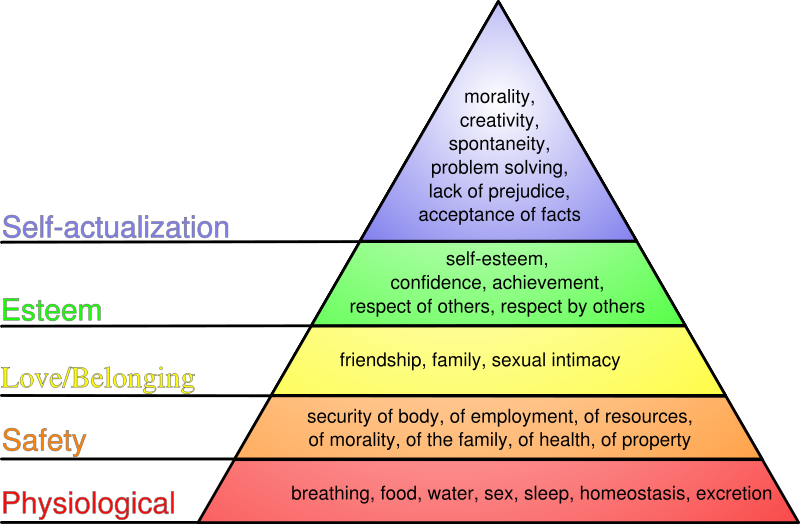
Maslow developed his theory of needs whilst researching the behaviour of primates. He found that every living creature has basic needs which must be fulfilled for it's survival. He stated that humans have the same needs but they are much more complex and allow humans to be unique from other species if fulfilled. Humans strive to be unique from others and fulfill their full potential in life (become self actualized.)
The diagram above illustrates this theory. Go from the bottom working up. The levels of need are described below.
Physiological needs - basic needs. Needs for survival, these must be met before you can move on to a high level.
Safety and Security - the need for protection and shelter.
Belonging Needs - social needs, the innate need for the love and affection of others.
Esteem Needs - split into two levels. Low self-esteem and high self-esteem. Low self-esteem depends on appraisal of others if others like us we feel better about ourselves if someone doesn't like us we feel hurt and low. High self-esteem is self respect and feeling good about yourself and is more stable and lasting.
Self Actualization - made up of being needs. These include affection, beauty, respect, diplomacy, uniqueness. If we achieve this stage in the hierarchy we will be realizing our full potential as human beings.
By Evie

No comments:
Post a Comment